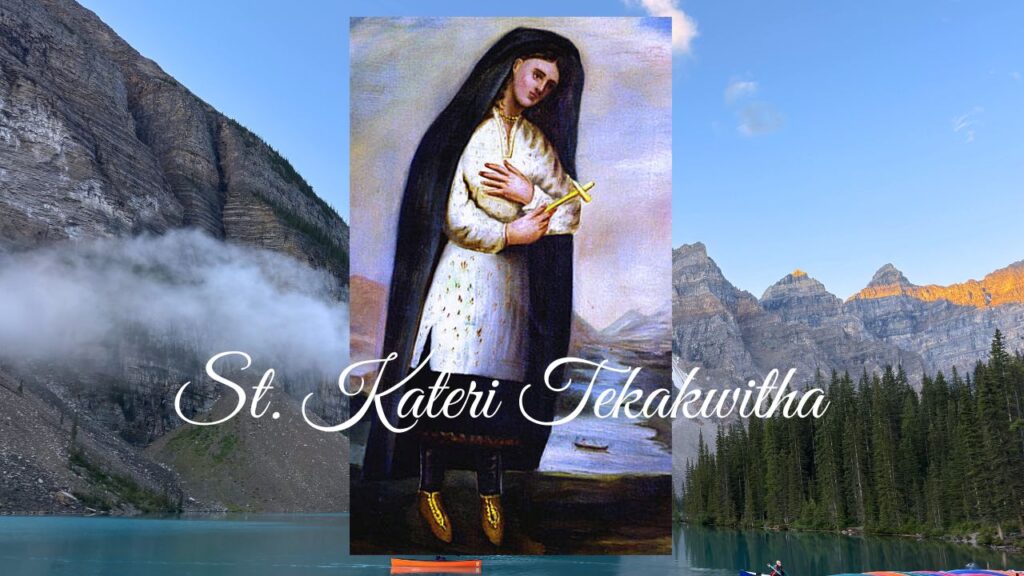
If you’ve ever felt “out of place” in your own culture, or carried scars—seen or unseen—St. Kateri Tekakwitha is a gentle, powerful friend. Known as the “Lily of the Mohawks” and the first Native American woman canonized as a saint, she shows us what it looks like to belong completely to Jesus in the middle of tension, loss, and misunderstanding. Wikipedia+2National Shrine+2
In this post, we’ll walk through her life, explore how the Church speaks about her, and reflect on what her witness means for our own healing, identity, and love for God’s creation.
Early Life: A Child of Two Worlds
St. Kateri Tekakwitha was born in 1656 in the Mohawk village of Ossernenon, in what is now upstate New York. Her father was a Mohawk chief, and her mother was a Christian Algonquin woman who had been previously instructed by French missionaries. Wikipedia+2Newman Connection+2
When Kateri was about four years old, a smallpox epidemic swept through her village. Her parents and baby brother died. Kateri survived, but the disease left her:
- With scars on her face
- With impaired eyesight
- Weakened and shy, often covering her face with a blanket
She was adopted by her aunt and uncle, members of the Turtle Clan, and grew up in a traditional Mohawk setting, marked by both rich culture and deep grief. Newman Connection+1
Her story echoes the psalmist’s words:
“The Lord is close to the brokenhearted and saves those who are crushed in spirit.” (Psalm 34:18)
From the very beginning, God was near to this scarred and quiet child.
Drawn to Christ: Baptism and a New Name
As she grew, Kateri encountered Jesuit missionaries who visited the Mohawk lands. Her mother’s Christian faith and the witness of these priests planted a seed in her heart. By her late teens, she felt strongly drawn to Jesus Christ, even though this choice brought suspicion and pressure from some in her community. Wikipedia+2Newman Connection+2
At about 19 years old, she asked for baptism. On April 18, 1676, she was baptized and given the name Catherine, which in Mohawk became Kateri, after St. Catherine of Siena. Wikipedia+2Catholic Women in Business+2
She resisted strong pressure to marry, choosing instead to belong entirely to Christ. Her famous words capture this total self-gift:
“I am not my own; I have given myself to Jesus. He must be my only love.” dioceseofraleigh.org+1
Her courage in saying yes to Jesus in a setting that didn’t fully understand her choice makes her a powerful patron for anyone who feels called to live differently for God.
“You are not your own; you were bought at a price.” (1 Corinthians 6:19–20)
A New Village of Faith: Life at Kahnawake
After her baptism, Kateri faced misunderstanding, ridicule, and hostility for her Catholic faith. Eventually, she journeyed north to a Christian Native village at Kahnawake, near Montreal in New France (Canada), where many Iroquois converts lived in community under the care of Jesuit missionaries. USCCB+3Wikipedia+3Newman Connection+3
There, she:
- Lived a life of prayer, work, and charity
- Helped the sick and elderly in the village
- Wove mats, sewed clothing, and supported the community with her hands
- Spent long periods praying in the forest, finding God in nature and silence
Kateri’s deep love for creation and her habit of encountering God outdoors are part of why she is honored today as a patroness of ecology, the environment, Indigenous peoples, orphans, people in exile, and those ridiculed for their piety. camptekakwitha.org+3Wikipedia+3National Shrine+3
Her life resonates strongly with the Genesis truth:
“God saw all that he had made, and it was very good.” (Genesis 1:31)
She teaches us that caring for creation and walking gently on the earth can be an expression of love for the Creator.
Suffering, Death, and the Miracle of Her Scars
Kateri’s health was always fragile. She embraced a life of chastity, prayer, and sacrifice, offering her suffering for the conversion of her people and the glory of God. She died on April 17, 1680, at only 24 years old. Wikipedia+2Newman Connection+2
Tradition tells us that her last words were, “Jesus, I love you.” Evangelist
Witnesses at her deathbed noted something extraordinary: within minutes of her passing, the smallpox scars that had marked her face since childhood were said to fade away, leaving her countenance peaceful and radiant. Thy Ship+1
For a woman whose visible scars had contributed to her shyness and sense of “difference,” this sign speaks powerfully. In Christ, the marks of her suffering were not erased from history—but they no longer defined her beauty. God’s love had the final word.
Saint for Our Time: Pope Reflections and Modern Devotion
Devotion to Kateri began soon after her death. She was:
- Beatified by Pope John Paul II in 1980
- Canonized by Pope Benedict XVI on October 21, 2012 Wikipedia+2Salt + Light Media+2
At the time of her beatification, John Paul II spoke of Kateri as a symbol of the best of Indigenous heritage, uniting Native culture and Catholic faith in a powerful way. Vatican
More recently, Pope Francis described her as a model of responding to God’s call with faith despite hardship, highlighting her as the first Native American saint of North America and a witness of apostolic zeal. Vatican+1
Today, shrines and devotions in her honor—such as those at Kahnawake and Auriesville—continue to invite the Church to:
- Honor Indigenous cultures
- Work for healing where there has been injustice
- Learn from her purity, courage, and love for God’s creation National Shrine+2Kateri+2
Although Kateri herself was not a member of a religious order, her witness has inspired religious communities and lay movements dedicated to Native ministry, ecology, and reconciliation. Several congregations and ministries serving Indigenous peoples claim her as a patron, and she is a special intercessor for Native Catholic communities across North America. Wikipedia+2Kateri+2
What St. Kateri Tekakwitha Teaches Our Hearts
For us at Spirit Love Song™, St. Kateri Tekakwitha is a companion on the journey of healing and belonging. Her life offers us several key invitations:
1. Your Scars Are Seen—and Held—by God
Kateri’s scars and fragile eyesight did not keep God from using her; they became part of the way she loved and prayed. If you carry physical, emotional, or spiritual scars, her story reminds you that God sees all of it and never turns away.
“My grace is sufficient for you, for my power is made perfect in weakness.” (2 Corinthians 12:9)
2. You Can Belong to Jesus Even When Others Don’t Understand
In a culture that expected her to marry, Kateri’s vow of virginity and total self-gift to Christ stood out. She shows us that the call of Jesus sometimes looks different from what others expect—yet it is deeply fruitful.
Her words are a beautiful simple prayer:
“I am not my own; I have given myself to Jesus.” dioceseofraleigh.org+1
3. Love God in Creation
Kateri found God in forests, rivers, and quiet paths. In an age marked by ecological crisis, she invites us to a tender, reverent love for the natural world, not as an end in itself, but as a reflection of the Creator.
“The earth is the Lord’s, and everything in it.” (Psalm 24:1)
4. Holiness Can Be Hidden and Gentle
Like St. Josephine Bakhita, Kateri did not found an order or travel the world. Her holiness bloomed in daily work, simple prayer, and quiet fidelity. That means there is room for your hidden, quiet love of God too.
A Prayer to St. Kateri Tekakwitha
St. Kateri Tekakwitha,
Lily of the Mohawks and daughter of the forest,
you carried scars on your face and heart,
yet gave yourself completely to Jesus.Pray for all who feel different,
all who have been wounded by sickness, ridicule, or rejection.
Help us to know that we are not our own,
but deeply loved and claimed by Christ.Teach us to meet God in silence and in creation,
and to live with courage, purity, and gentle love.St. Kateri Tekakwitha,
pray for us and for all peoples of this land.
Amen.
Bibliography / Sources
- Wikipedia – “Kateri Tekakwitha” – biographical overview, early life, conversion, move to Kahnawake, canonization details. Wikipedia
- Newman Ministry – “Saint Kateri Tekakwitha” – narrative of her family background, smallpox epidemic, adoption, and faith. Newman Connection
- National Shrine of the Immaculate Conception – “St. Kateri Tekakwitha: The Lily of the Mohawks” – patronage for ecology and the environment, overview of devotion. National Shrine+1
- Diocese of Raleigh – Native American Catholic Community: “Saint Kateri Tekakwitha” – extended quote on her self-gift to Jesus. dioceseofraleigh.org
- USCCB / Vatican / Pope Francis General Audience (30 Aug 2023) – reflections on St. Kateri as first Native American saint and model of apostolic zeal. Vatican+1
- Bishop’s homily, canonization reflection & other devotional sources – testimony about the disappearance of her scars after death and early devotion. Thy Ship+2Evangelist+2
#StKateriTekakwitha
#LilyOfTheMohawks
#CatholicSaints
#IndigenousSaint
#CareForCreation
#EcologyAndFaith
#HealingInChrist
#ScarsAndGrace
#CatholicSpirituality
#SpiritLoveSong
#JesusITrustInYou
#SaintOfTheDay